
Compressed Air System Design, Installation and Piping in Southern California
CAGI calls compressed air the fourth utility in most plants, after electricity, water and gas. Get the system wrong and you pay for it every day it runs. We install complete systems across Los Angeles, Orange, Riverside and San Bernardino counties: sizing, compressor, dryers and filters, storage, piping and startup. Authorized for Chicago Pneumatic, Powerex, Pneumatech, Mark Compressors and Donaldson. Call (844) 310-8665 to start a project.
What a Full System Installation Covers
We install the whole system, not just the compressor: sizing, equipment, piping, storage, treatment, controls and startup.
-
Load assessment and equipment selection
We measure your real air demand first (CFM at the point of use, peak demand and run times) using the method in our air compressor sizing guide. Then we pick the type: oil-flooded rotary screw for most plants, piston, scroll or oil-free where the job needs it. Variable speed saves energy when demand swings, and your load profile tells us if it’s worth it. With more than one compressor, we set up sequencing so the machines share run hours and you never run more than you need.
-
Air treatment selection
Refrigerated dryers for general plant air, desiccant where you need a -40°F dew point or lower. CAGI’s rule: dew point should sit 20°F below the coldest temperature your piping will see. Filters are matched to ISO 8573-1 air quality classes. See dryer selection and moisture troubleshooting.
-
Storage and receiver sizing
We size tanks at CAGI’s minimum of 10 gallons per CFM of the largest trim compressor. As CAGI puts it, storage is “the one variable in a compressed air system that can never be oversized.” Too little storage pushes system pressure up and wastes energy. We split it about one-third wet (before the dryer) and two-thirds dry (after).
-
Distribution piping
Main lines are sized to keep air under 30 ft/sec, and wet lines under 20 ft/sec, so you don’t lose pressure or carry water downstream. We use aluminum or black iron. PVC isn’t approved for compressed air under OSHA guidance, whatever its pressure rating. More on piping.
-
Controls and commissioning
At startup we set pressure, load and unload points and safety shutdowns, and program sequencing if you have more than one compressor. We record a baseline of pressure, flow, temperature and power that your maintenance tracks from then on.
Compressed air piping and distribution
The piping that gets air from the compressor room to your machines: headers, loops, branch lines and drops, for new plants, expansions and equipment moves. We look at flow, pressure, air quality and your shutdown window before picking pipe. We can quote piping on its own or with the rest of the system.
-
New lines, expansions and upgrades
Main headers and loops from the compressor room to production; new machine drops, branch extensions and rerouting after layout changes; and fixes for restrictive runs, leaking joints and bad drops. We check the old pipe’s condition and spare capacity before extending it, and set isolation zones so the work fits around production.
-
Sizing, layout and pressure drop
Pipe sized from compressor horsepower alone can miss the real load. We size from CFM at your operating pressure, peak demand when machines run together, the minimum pressure critical equipment needs and future growth, and count the equivalent length of fittings, valves and bends. A loop gives air two ways to travel, but layout and load still decide the result. We set a project-specific pressure-drop target and check it at commissioning.
-
Finding the real restriction
We compare pressure under normal load at the compressor, dryer and filters, header and machine inlet, separating pipe pressure drop from dryer losses, tight hoses and couplings, leaks and capacity problems. Turning compressor pressure up can hide a restriction and costs energy. Not sure why pressure is low? Start with a compressed air system assessment.
-
Materials and condensate
Modular aluminum, copper, carbon steel and stainless each have their place; pipe, fittings, seals and joints all have to be rated for your pressure and temperature. We place takeoffs and low points to keep water out of machines, with drains you can reach. Ordinary plumbing PVC isn’t for compressed air, and air quality has to hold all the way to the point of use.
-
Tie-in and shutdown
We agree shutdown windows, isolation and lockout, lifts and access, other trades and restart checks before anything is scheduled, plus leak checks, pressure checks under load, valve labels and handover records. Contractors can buy the materials or hand us the piping scope; the proposal spells out who does what.
-
References we use
Compressed Air Best Practices: Compressed Air Piping Distribution Systems and Pressure Loss Solutions for the Last 30 Feet. Use a piping schematic to choose where to measure pressure, and watch for short-duration demand at individual machines. Their examples are specific to those plants, not Toolytics results or design guarantees. Also CAGI: Working with Compressed Air.
Getting the System Design Right
U.S. Department of Energy data shows that over 10 years, a 75 HP system’s cost is about 76 percent electricity, 12 percent purchase price and 12 percent maintenance. The invoice is the small part. How well the system is sized and maintained decides the rest.
Undersized, a system runs flat out, runs hot, wears faster and may not keep up at peak. Oversized on a fixed-speed compressor, it spends a lot of time unloaded, still drawing 35 to 40 percent of full-load power. Variable speed fixes that, but only if your demand actually swings.
We carry several brands, so we pick equipment for your application, budget and timing, not to push one product line.
Not sure what you need? A compressed air assessment gives you the load profile before you buy.
Why Replacement Is Also an Opportunity
Most compressors reach repair-or-replace around 8 to 10 years or 40,000 to 50,000 hours. The system is coming down anyway, so that’s the time to fix piping, storage and layout. Once the new unit is in, those fixes mean another shutdown.
Piping that’s too small now. It was sized for the plant years ago. More shifts or equipment can mean pressure drop and wasted energy, and CAGI notes old steel pipe gets rougher as it corrodes.
The wrong type for today’s demand. A fixed-speed unit on a load that swings all day wastes energy, and electricity is about 76 percent of the cost.
Not enough storage. Undersized tanks cause pressure swings and short cycling. Adding storage is easy while the system is already down.
A system assessment before you spec the replacement keeps you from repeating old mistakes.
How it works
From the first call to startup.
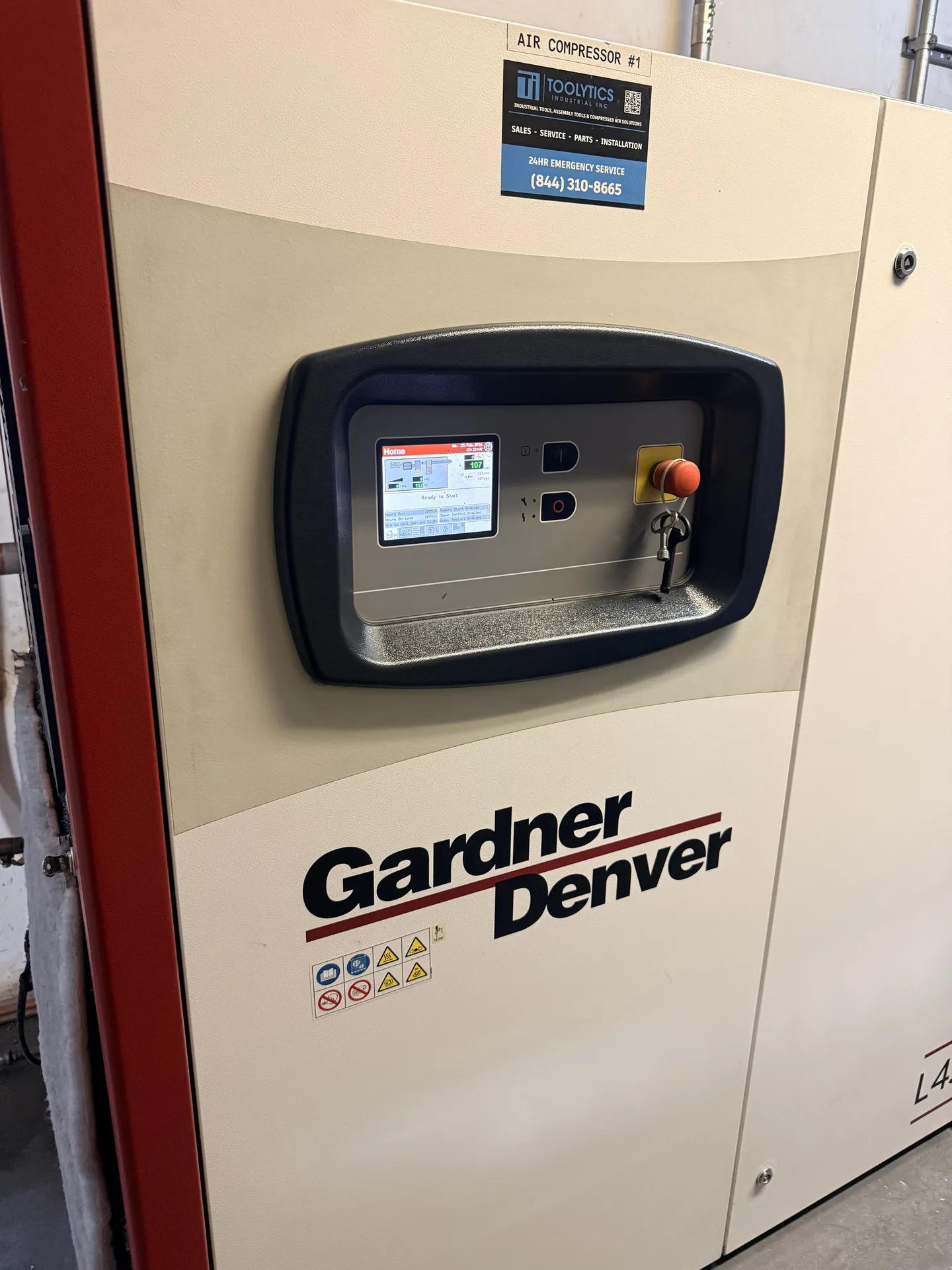
Picking the compressor is one part of the job. We look at the site, the dryers and filters, and the piping together so the scope is clear.
-
Initial consultation
Call (844) 310-8665 or send a request. Tell us what’s going on: an aging unit, a new building or a planned upgrade. Equipment type and location are enough to start. We won’t spec equipment over the phone.
-
Site assessment and load survey
We visit, document the current system or the empty space, and measure real air demand: CFM at the point of use, peak periods and run times. If a full system assessment makes sense first, we’ll quote that separately.
-
System scope and proposal
We put together a proposal with the equipment, specs and price. Nothing is ordered until you approve it.
-
Installation
We deliver, set and install the equipment to manufacturer specs, run and connect the piping, and set up the dryers, filters and controls. Lead times depend on the model and manufacturer, and we give you the current estimate with the proposal.
-
Commissioning and baseline documentation
We start it under load and record pressure, temperature, power and dew point. That’s the baseline your planned maintenance tracks. We confirm it’s running to spec before we leave.
What to send for a quote
Send what you have: site ZIP and target date, the equipment or application, CFM and pressure, shutdown window, supply-only or installed scope, and for piping the rough distances, number of drops and current pipe material. We’ll tell you what still needs measuring. Tell us about drawings or bid documents and we’ll set up a way to get them.
Common questions about installation and piping
-
How long does a compressed air system installation take?
It depends on the job. A straight compressor swap with good existing piping and treatment often takes one to two days. A full system with new piping, tank, dryers and controls usually takes three to five days on site, plus equipment lead time. You get a timeline in the proposal.
-
How do you determine the right size compressor for a facility?
We measure first. A site visit and load survey gives us real CFM at the point of use, peak periods and run times. That drives the spec, not a rule of thumb. A wrong-size compressor costs you for years.
-
What is the difference between a VSD and a fixed-speed compressor, and which one do I need?
Fixed-speed runs at full load or unloaded. Variable speed (VSD) changes motor speed to match demand, which saves energy when demand swings. Steady demand all shift? Fixed-speed may be right. Demand that changes by shift or season? VSD usually pays off. CAGI says VSD saves energy in many applications, not all, so we check your load first.
-
Will larger piping solve low pressure at our tools?
Maybe, if the piping is the restriction. Measure pressure under normal demand at the compressor, dryer and filters, header and critical machines. Clogged filters, small hoses, leaks, controls or too little compressor can also cause it. Find the cause before picking pipe sizes.
-
Should we use a loop or a straight header?
A loop feeds demand from two directions and makes future drops easier. A straight header can suit a smaller or long, narrow building. It depends on layout, demand, equivalent length, isolation and growth plans. A loop alone doesn’t guarantee enough pressure.
-
Can Toolytics work with our general or mechanical contractor?
Yes. The proposal spells out materials only versus our installation or subcontract scope, and who handles drawings, permits, supports, electrical, shutdown coordination, testing and startup. What we can install depends on the location and site.
-
Should we assess the current system before replacing the compressor?
Usually, yes, especially if the piping or storage was sized for a different load. An assessment shows your real demand and any piping problems to fix during the same shutdown, so you don’t just copy the old unit’s specs. See our system assessments page.
Serving Los Angeles, Orange County, and the Inland Empire
Most of our installation work is here:
Los Angeles County
Vernon, City of Industry, Carson, Long Beach, Santa Fe Springs, Torrance, El Monte, and Compton.
Orange County
Anaheim, Santa Ana, Garden Grove, Fullerton, Buena Park, and Brea.
Inland Empire
Ontario, Fontana, Riverside, Rancho Cucamonga, Moreno Valley, San Bernardino, and Pomona.
Inland Empire heat. Compressor rooms here often hit 95 to 100°F in summer, past the limit for some equipment and a big factor in ventilation. A dryer sized without that in mind may not hold your dew point in July and August. We size for it.
We also do compressed air installation in Las Vegas and Clark County: replacements, added capacity, dryers and filters, storage, piping and startup. California is fully staffed. Nevada has active equipment and service support. Arizona equipment supply and project-scoped installation or service are quoted for each site.
Request an Installation Consultation
We start with a site visit and load survey and build the system from there. Fill out the form and we’ll follow up within one business day, or call (844) 310-8665.
Once it’s running, a maintenance agreement keeps it at spec.